Dressed to Be Seen: Beau Brummell and the Rise of Black Dandyism

Updated: Sep 25
In the opening installment of this series, we met George Bryan “Beau” Brummell, the middle-class Englishman who persuaded princes and aristocrats to follow his lead.
Brummell rejected the extravagant colors, powdered wigs, silk stockings, and elaborate ornamentation of eighteenth-century men’s fashion. In their place, he promoted disciplined grooming, immaculate linen, carefully tied neckwear, full-length trousers, dark coats, and tailoring so precise that the finished appearance seemed effortless.
His clothing communicated restraint, confidence, taste, and command.
For Brummell, fashion was not simply something worn on the body. It was a means of constructing a public identity. A man without an ancient title could nevertheless walk into an aristocratic room and behave as though he belonged there. Through dress, wit, composure, and bearing, Brummell fashioned himself into someone whose approval was sought by men born far above him in Britain’s social hierarchy.
But when the language of dandyism traveled beyond Regency England, it entered a world of vastly different experiences and far greater consequences.
Black people would take the tools associated with dandyism—tailoring, refinement, self-possession, disciplined presentation, and visual distinction—and transform them into something Brummell could never have imagined.
That transformation became known as Black dandyism.
More Than Fine Clothes
At first glance, Black dandyism might appear to mean little more than Black men wearing elegant clothing.

That definition is far too small.
Black dandyism is a cultural tradition in which clothing and personal presentation become instruments of identity, resistance, imagination, dignity, and freedom. It draws upon the European figure of the dandy, but it does not merely imitate him. It reshapes and expands the idea through the experience of people whose bodies, movement, labor, citizenship, and public identities were subjected to racial control.
The Black dandy did not simply put on a well-cut suit.
He used that suit to make an argument.
The argument might be quiet or flamboyant, conservative or rebellious. It might declare respectability, professional accomplishment, artistic freedom, masculine confidence, gender fluidity, racial pride, or all of those things at once.
But beneath its many forms was a common insistence:
I will participate in defining who I am.
Black dandyism emerged as a recognizable cultural force during the nineteenth and early twentieth centuries, particularly after emancipation and during the Harlem Renaissance. Its deeper roots, however, reach into the centuries of slavery, when clothing could be imposed upon Black people as a marker of servitude, status, or ridicule.
To choose one’s own appearance in such a world was never entirely superficial.
It was an exercise of agency.
The Body as Contested Ground
Clothing has always carried social meaning. It can identify occupation, wealth, religion, gender, rank, region, or membership in a community. In a racial society, however, clothing could also become part of the struggle over who was permitted to appear dignified, powerful, prosperous, educated, or free.
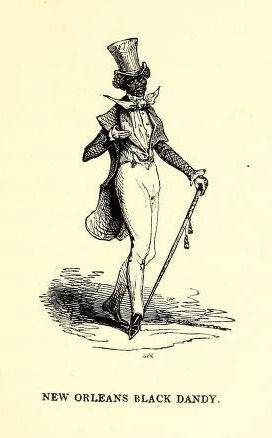
For generations, racist imagery portrayed Black people as disorderly, childish, inferior, dependent, or incapable of refinement. Minstrel shows and cartoons frequently turned the well-dressed Black man into a caricature. His clothing was represented as a costume, his refinement as pretense, and his ambition as something deserving ridicule.
The mockery revealed an uncomfortable truth.
A Black person who appeared confident, sophisticated, and fully in command of himself threatened the racial story that white society had constructed around him.
The clothing did not create the threat. The self-possession did.
The Council of Fashion Designers of America describes Black dandyism as a strategic use of dress through which Black people challenged racial hierarchy and asserted autonomy. By adopting—and then creatively revising—forms of clothing historically associated with European power and privilege, Black dandies disputed the assumption that refinement, authority, and social mobility belonged exclusively to white people.
This was fashion as argument.
It was elegance with historical weight.
Borrowing the Language, Rewriting the Message
Beau Brummell demonstrated that clothing could help a person negotiate social rank. Black dandies inherited that language but used it under fundamentally different circumstances.

Brummell was navigating class distinctions within a society that still recognized him as a free white Englishman. Black men and women used clothing while confronting slavery’s legacy, segregation, racial violence, exclusion from institutions, restrictions upon movement, employment discrimination, and constant attacks upon their citizenship.
The comparison, therefore, must be made carefully.
Brummell’s dandyism helped a commoner move among aristocrats. Black dandyism helped people denied social equality assert their humanity in public.
Black dandies borrowed elements of European tailoring without surrendering their own identities. They changed proportions, colors, combinations, gestures, and meanings. They combined traditional formalwear with African diasporic influences, regional styles, popular music, nightlife, religious culture, political activism, and neighborhood creativity.
They did not merely enter an existing fashion tradition.
They remade it.
A dark tailored suit could convey professional discipline. A brilliantly colored tie, polished shoes, dramatic hat, patterned waistcoat, or carefully chosen accessory could announce individuality. An exaggerated silhouette could reject restraint altogether. The same person might use conservative elegance in one setting and visual spectacle in another.
Black dandyism could operate within established social codes while simultaneously testing, bending, or overturning them.
Respectability—and Its Limits
Following emancipation, refined dress became closely associated with the politics of respectability.

Black educators, ministers, physicians, lawyers, business owners, journalists, political leaders, and civil-rights advocates understood that photographs and public appearances could counter racist representations. Figures such as Booker T. Washington and W.E.B. Du Bois presented themselves with deliberate formality because they recognized that images traveled and that appearances could become part of a larger political message.
A portrait of a dignified Black professional offered visual evidence against a society determined to deny Black achievement.
Yet respectability was complicated.
No degree of elegance could guarantee safety, equality, or acceptance. A perfectly tailored suit could not repeal a segregation law. Immaculate grooming could not prevent racial violence. Polished shoes could not open every school, hotel, restaurant, profession, or ballot box.
Black dandyism therefore should not be reduced to an attempt to win white approval.
At its most powerful, it was not a plea to be accepted. It was a declaration of self-worth whether acceptance came or not.
The Black dandy might satisfy conventional expectations of respectability—or deliberately exceed them. He could appear more polished than the people attempting to exclude him. She could appropriate the structure of menswear while challenging assumptions about gender. They could use elegance not to disappear into society but to become impossible to overlook.
The Silent Parade: Elegance in Protest
One of the most striking demonstrations of dress as political language occurred in New York City on July 28, 1917.
Thousands of Black men, women, and children marched silently down Fifth Avenue to protest lynching, racial violence, and the deadly attack upon the Black community of East St. Louis. Many participants wore formal clothing. Men marched in dark suits while women and children wore white.
There were no shouted slogans.
The disciplined procession, solemn clothing, and silence carried the message.
Here were Black citizens presenting themselves not through the degrading stereotypes of the Jim Crow era, but through their own carefully controlled image: organized, dignified, grieving, determined, and unmistakably present.
The protest demonstrated one of the essential powers of Black dandyism and Black visual culture. Appearance could become collective testimony. Clothing could contribute to the moral force of a public action. A body that society attempted to marginalize could occupy one of the nation’s most prominent avenues and demand to be seen on its own terms.
From Harlem to the Zoot Suit
During the Harlem Renaissance of the 1920s and 1930s, Black artists, writers, musicians, intellectuals, performers, and residents embraced new forms of cultural experimentation.
Clothing became part of that creative awakening.
Tailored suits, evening clothes, fur-trimmed coats, hats, gloves, canes, polished shoes, and daring combinations of color appeared in studios, clubs, theaters, churches, photographs, and city streets. Style participated in the larger project of defining the “New Negro”—a modern Black identity no longer willing to be confined by degrading images inherited from slavery and minstrelsy.
Black dandyism could be refined and restrained, but it could also be exuberant.
The zoot suit made that abundantly clear.
With its broad shoulders, long jacket, high-waisted trousers, generous fabric, and dramatic silhouette, the zoot suit occupied physical and visual space. It was popular among Black, Mexican American, Filipino American, and other young men who transformed it into a symbol of urban style.
The suit’s proportions made modesty impossible.
Its wearer would be noticed.
That visibility helped make the zoot suit controversial. During the 1940s, it was condemned as wasteful, unpatriotic, criminal, and threatening. The clothing itself became a pretext for policing the young men who wore it. During the 1943 Zoot Suit Riots in Los Angeles, servicemen and police attacked young men associated with the style.
The reaction again revealed that the controversy was never merely about fabric.
The real question was who had the right to be visible, expressive, confident, and unapologetic in public.
Style as an Expanding Tradition
Black dandyism did not end with the Harlem Renaissance or the zoot suit.
Its spirit appeared in the carefully cultivated images of artists, musicians, intellectuals, athletes, activists, and entertainers. Dizzy Gillespie, Duke Ellington, Sammy Davis Jr., Malcolm X, James Baldwin, André Leon Talley, Dapper Dan, Janelle Monáe, André 3000, Pharrell Williams, Colman Domingo, and many others have used clothing as part of a larger language of identity.
Some embraced classic tailoring. Others disrupted it.
Some projected disciplined masculinity. Others softened or expanded the boundaries between masculine and feminine presentation. Some worked within European sartorial traditions, while others combined luxury clothing with streetwear, music, African diasporic aesthetics, and distinctly Black cultural invention.
The tradition is not restricted to men. Black women, queer people, and gender-nonconforming artists have also used dandyism’s vocabulary of tailoring, performance, and self-invention to challenge the limits placed upon them.
That adaptability is one reason Black dandyism has endured.
It is not a uniform.
It is a method of self-authorship.
From the Margins to the Met
In 2025, Black dandyism received one of its most visible institutional recognitions when the Metropolitan Museum of Art’s Costume Institute presented Superfine: Tailoring Black Style. The accompanying Met Gala adopted the dress code “Tailored for You.”
The exhibition organized the story around ideas such as ownership, presence, distinction, disguise, freedom, respectability, heritage, beauty, and cosmopolitanism. Those words demonstrate how far the subject extends beyond clothing.
The exhibition did not suddenly make Black dandyism important. Black communities had understood its power for generations.
What it did was place that history inside one of the world’s most prominent cultural institutions and insist that Black style be studied as history, art, politics, and intellectual expression—not merely as entertainment or trend.
That recognition also underscored the importance of preservation. Clothing is fragile. Photographs become separated from names. Club records disappear. Newspapers deteriorate. Families inherit objects whose stories may be lost within a generation.
When Black sartorial history is not documented, its innovations can be detached from the people and communities that created them.
Preserving the image is important.
Preserving the name, place, occasion, and meaning behind the image is essential.
A Name Begins to Travel
Beau Brummell could not have foreseen any of this.

He could not have imagined that the aesthetic language associated with his name would one day intersect with struggles over emancipation, citizenship, racial representation, masculinity, dignity, and freedom. His carefully tailored clothing helped him negotiate the hierarchy of Regency England. Later generations would use elegance under circumstances in which the stakes were infinitely greater.
The connection was not imitation alone.
It was transformation.
The Black dandy took the idea that a person might fashion himself through appearance and asked a more profound question:
What happens when people denied the right to define themselves seize that power anyway?
The answer would not remain confined to Harlem, New York, or the great fashion centers of America.
The language of distinction traveled.
So did the name.
It moved into cities large and small, entered communities confronting the daily realities of Jim Crow, and acquired purposes far removed from the London drawing rooms where Beau Brummell first became famous.
Eventually, it would reach places much closer to home. Much closer.
And it will be remixed again. This time in a lasting and unexpected way?
But that part of the story must wait for the next installment.
-T
Sources
This article draws principally upon the Council of Fashion Designers of America’s “Delving into the Essence of Black Dandyism” and the historical overview and cited scholarship assembled in the Black dandyism entry on Wikipedia.

