Meet the Board: Treasurer Dr. Travis L. Gosa

Updated: 2 hours ago

The next installment of meet the Board of Directors of the Eugene and Beverly Stradwick Heritage Foundation.
Some interviews arrive as answers.
Others arrive as a walk.
For Dr. Travis L. Gosa, the newest installment in our Meet the Board series begins not with a resume, but with a question he has heard many times over the years:
“You’re from where?”
"You are from where?” Over the years, I have grown accustomed to the confusion, shock, and occasional excitement when people grapple with the fact that I was born and raised in Wheeling, West Virginia.
“Right, so, not far from the beach? My in-laws have a beach house in Virginia.” I was recently informed by a neighbor, while waiting around the pickleball courts. Apparently, someone Uno Reversed Abe Lincoln’s 1863 proclamation, which created and severed the state from our Confederate brothers and sisters of (East) Virginia. To help clear up the geographical confusion, I still enjoy giving people the middle finger, flipped bird, or so-called WV salute. Extending your middle finger, while keeping your thumb stuck out, approximates the shape of the state and its two panhandles, and can quickly be used to explain how being raised in WV could possibly mean in the Ohio Valley; on the Ohio River; not being a southerner; or that I attended an in-state college outside of Washington, DC (Shepherd University).
“Are there black people in West Virginia?” Likewise, the skin complexion and friendly city pedigree can elicit glances of disbelief, fear, and concern for my safety. Being asked how a brother survived the Appalachian monsters of The Mothman Prophecies (2002), the serial killer of Silence of The Lambs (1991), the forest cannibals of Wrong Turn (2003) demonstrates how popular culture images can overshadow a place.
Two things can be true: yes, some of the hills do have eyes, and yes, there are black people in West Virginia. The African diaspora can and always will be found in the hills and hollers, fishin’ down by the creek (read: “crick”). In the late 1990s, I even saw a compadre waving a Confederate flag while singing a ditty at the old Jamboree In The Hills--but that’s a complicated story for another day.
West Virginia is both wild and wonderful.
The opportunity to illuminate, and indeed, to celebrate, the rich cultural and social legacy of said black folk–as an integral part of the city and state’s past, present, and future–is one of the primary reasons I am honored to serve on the executive board of the Eugene and Beverly Stradwick Heritage Foundation. As a sociologist, the opportunity to facilitate research projects on the oft overlooked and neglected peoples and histories of my hometown is exciting. As a native, it provides an excuse to hum the chorus of John Denver’s “Country Roads” (“Take Me Home”).
And, as one of many grandchildren of Eugene and Beverly Stradwick, this return home has caused me to think a great deal about Lind St., specifically, what it might have meant to be a kid on that curved and windy street in the early 1980s. Playing around my grandma and grandpap’s Lind St. house is how I spent most of my preschool years. Importantly, this autobiographical stroll down memory lane might help demonstrate why hyper-local history matters, and what might be implied by amorphous concepts like “legacy” and “heritage.” A small chunk of Lind St.–exactly three buildings and the actual street–continues to hold a special meaning for me. For future generations, it might provide a reminder about the importance of preserving memories as well as physical reminders of the past.
And certainly not a place without Black people.
All Roads Lead Back To Lind Street
For anyone wishing to develop a deeper understanding of local history and cultural heritage, I suggest walking towards the top of Lind St. in Wheeling, WV.
Instead of driving directly there (GPS location 1104 Lind St), park on the corner of Wood and 14th, and start walking. As you ascend the steep incline, notice the aged, stone retaining wall that runs along the sidewalk on one side. Sets of eroded concrete stairs in the overgrowth mark where multi-level houses were once anchored into the steep hillside.
If this is a nighttime excursion, don’t think about the above-mentioned horror movies. If it wasn’t for the overgrown bushes and creeping vines, crumbling porches, and distressed houses with boarded up windows, Lind St. might (not) be mistaken for Mulholland Drive in the Hollywood Hills. When things eventually flatten out, you have arrived at your destination.

If you start the decline past Cherry St., you’ve gone too far. On one side of the street, remains a large two-story yellow house with an oversized deck–that home served as the former James Paige Learning Center in the 1990s. Turn around and look towards the hill. What do you see?
The answer: not much, few people, usually.
Things were different forty to fifty years ago.
From the Cherry St. corner, would have stood The Playmate, a tavern of sorts, at 1102 Lind; on the right, would have been Nieder’s, a small corner store, at 1106 (which is still standing and currently serving as a Masonic organization; nestled in between what would have been my grandparents’ home–the epicenter of my early childhood and a once vibrant neighborhood. Four decades ago, beyond the physical structures and modest, but well-kept homes, the most notable thing would have been the sound of children playing, screaming, and laughing, and the constant hustle and bustle of a neighborhood bar.

Music being played from boomboxes and car 8-track players–maybe some Earth, Wind, and Fire or Jackson 5–people grilling food on the sidewalk. Maybe the faint smell of menthol cigarettes (Kool with a K or Newports).
It is fair to say, this street was literally “lit”--as my teenager has informed me–back in the day. However, here, I want to briefly describe what all of this looked like through the eyes of a pre-schooler.
We Outside: The Games We Played
Almost a half century ago, outside Eugene and Beverly’s house, you would have seen dozens of kids, outside, on porches, sidewalks, and in the street. On a typical day in 1984-ish, I would guestimate thirty-two or so youths, with at least twenty who claimed, somehow inexplicably, to be a Stradwick, or cousin–kinfolk, on somebody’s mama’s side, third removed.
Back then, it was normal and expected that children were outside. Long before hip hop made “outside” a euphemism for questionable behavior (and usually with a disposition for retaliatory violence, ergo to pull up outside), playing, socializing–indeed, living–meant not being in the house. Perhaps to the surprise of my older siblings and family members, because I am almost a decade younger, I actually have no authentic memory of actually being inside my grandparent’s Lind St. home.
Some might say that we were free range kids. There were no helicopter parents. Parental oversight was so loose that, as legend would have it, a group of neighborhood teens once rode their pedal bicycles all the way to the Ohio Valley Mall–that is, 15 miles away to St. Clairsville in the state of Ohio–without any adults knowing about the adventure. This bit of oral history may be mostly “cap,” yet the fact remains that as long as you were back home, or back on someone’s front porch before the street lights turned on, you could avoid being “grounded.” And by grounded, I mean grounded outside–not allowed to leave a stoop or steps or porch, the punishment being forced to watch everyone else have fun from afar.
What did kids do all day?
Play street games, literally, in the middle of the street. Pickup football, which was usually interrupted every few minutes by oncoming traffic. Kickball, a self-explanatory game that could grind to a halt whenever the ball was kicked either into the wheel drum of moving or parked auto, or worse, when someone was silly enough to kick the ball hundreds of yards over the hill to McColloch St. We played all variations of “tag,” including “it” and “freeze,” with the safe zone or “base” being the front porch of my grandparent’s house.

In the fall, “monkeyballs” were used for street stickball, kickball, and bowling balls. For those not from West Virginia or Appalachia, monkeyballs or hedge apples are bright green, grapefruit or watermelon sized fruits that look like bumpy brains. Kids were always throwing them. When broken, they rotted and smelled awful.
We didn’t have i-Phones or Xbox, though there may have been a ColecoVision and Atari 2600. Instead, there was “I–imagination” and cardboard boxes. Acquiring (read: stealing) cardboard boxes from The Playmate or Nieder’s Store meant building a pretend fort and clubhouse in the woods above Cherry St. In the breakdancing craze of the early 1980s, a couple of large cardboard boxes could transform the sidewalk or grandpap’s porch into a makeshift dancefloor. Everyone thought their windmill or headspin were as good as Ozone’s or Turbo’s from Breakin’ (1984) and Breakin’ 2: Electric Boogaloo (1984).
When it rained, options included sitting on the porch, or jumping off the porch. The former might involve a friendly game of “that’s my car.” Basically, this meant watching cars go by. When you saw one that was a special fly or nice–like an Oldsmobile, Lincoln Continental, or great big Cadillac “with the diamond in the back/sunroof top” (hear William DeVaughn’s Thankful For What You Got, 1974)--the goal was to be the first person to scream “that’s my car.” For a split second, it was as if you were actually the owner of that car, until someone else yelled, “no, that’s my car,” in protest.
The latter, least imaginative, but athletic game, involved jumping off the three-foot porch of my grandparents house. Jump off, then climbing back up, or walking back around, and jump off again–for hours. Not surprisingly, using a porch or a wall as a parkour course resulted in the occasional sprained ankle or wrist.
The Playmate as Playground

Integrity matters in compiling history, and one ugly truth about growing up on Lind St. also, by default, meant growing up outside of a bar: The Playmate Lounge. Some of the oral history projects already conducted (see dissecting Wheeling - Playmate Bar on Lind Street. There is actually a great photo of a kid sitting by this payphone) has pointed out that for adults, The Playmate might be described as a local wateringhole, poolhall, social club, speakeasy–and allegedly a hotbed of grey-area activity such as prostitution, a dropoff spot for illicit packages, and an outlet for “boosted” (read: shoplifted) wares.
To this colorful history, I would only emphasize that it was not unusual for school-aged children to go inside this seedy joint. For neighborhood kids like myself, The Playmate also functioned as a bodega of sorts: For a quarter, you could ask the bartender for one of those big pickles that float around in the big jar, or the prepackaged, heavily processed hot meat stick. Similar to a Slim Jim, the sausage was a double treat–eat the “meat,” then slurp the hot sauce juice from the package. At some point, the downstairs also functioned as an arcade, with a PacMan tabletop machine.
Outside, The Playmate became a type of de facto playground for my tiny world. In the summer, I vividly recall using The Playmate payphone as a makeshift or impromptu basketball hoop. Here were the rules: a basket was scored if you could throw and land a ball on top of the payphone. Some days, chalk on the concrete sidewalk indicated different scoring options, such as foul shots and three pointers. In the winter, on cold, snowy sort of rainy, slushy days, the hill beside the Playmate wall and stairs also served as a small sledding course. We used discarded Miller Highlife and Bartels & James cardboard boxes as sleds.
What were some of the consequences of hanging outside of The Playmate as a pre-school aged kid? Well, two things: a tendency to talk to, and take money from strangers, and the occasional sighting of celebrities. I’ll start with the infamous characters.
I have fond memories of those special days when patrons would walk out of The Playmate bragging about hitting a trifecta or straight at the track. Translation: they had won big money gambling on the greyhound racing at Wheeling Island National Downs that day. Lucky winners would sometimes pass out quarters and even dollar bills to the neighborhood kids.
With this amazing windfall, I remember the joy of being able to walk about thirty feet to the neighborhood store called Nieders. With the gifted prize money, one could walk out with not only a brown bag of penny candy, but even splash out on $.10 cent boxes, cardboard boxes of LemonHeads, Boston Baked Beans, and Red Hots. The great thing about those old-school boxes of candy is that once you were done eating the contents you could use the box as a toy musical instrument. By closing both ends and blowing on one end, the lemon head or Boston baked bean box became a sort of harmonica or recorder.
That loot could also buy a Dr Pepper “pop,” the name brand good stuff instead of off-label brands like Faygo and RC Cola. I’m told, yet I don’t quite remember, that I was such a big fan of Dr. Pepper that I regularly wore a white “I’m A Pepper” t-shirt, which garnered me the endearing nickname Pepper. I do know that my Aunt Sharon continued to call me Dr. Pepper two decades later, after I achieved the actual title of “Dr” (PhD not MD).

On the other hand, there was at least one older gentleman who would attempt to borrow (“bum”) change from anyone around The Playmate, including children. I won’t say his name, but I remember him standing or sitting by The Playmate wall, typically holding a brown paper bag, conspicuously in the shape of a Mad Dog 20/20, Wild Irish Rose, or some other “rotgut” liquor. Often incoherent, intoxicated, and mumbling, he would take swigs from his bottle, then backflips–amazingly, without falling or breaking his neck on the concrete. Picture in your head a “wino” Simone Biles. By the time I became old enough for elementary school, I recall this same gentleman offering to walk kids back down the hill past a house on Lind St. that had the meanest Rockweiler and Pitbulls.
Lastly, I would be remiss not to mention that on rare occasions celebrities could be spotted at the Playmate. Outside, I met the Junkyard Dog! One of my childhood heroes during the 1980s wrestling boom, the Junkyard Dog was an iconic black WWF star, known for his dog collar, signature THUMP powerslam, and feud with King Kong Bundy. His gimmick was to turn the wrestling ring into a funk dance party. While innocent on the surface, “Grab Them Cakes,” the Junkyard Dog’s theme song and novelty dance, was filled with adult-themed, sexual innuendos. Likewise, I remember the street buzzing for days with the rumor that members of the R&B group DeBarge were down at the Playmate. I don’t know if it was El, Bunny, Randy, or Mark DeBarge, or whether any of the autographed cocktail napkins were authentic. But I can confirm that their "Rhythm of the Night” (1985), from the soundtrack of Berry Gordy’s urban kung-fu flick The Last Dragon, remains one of my favorites decades later.
A Few Concluding Thoughts On Preserving Cultural Heritage
In this self-reflective stroll down the memory lane of early 1980s Lind St, I have attempted to recount only what I remember, based on fuzzy feelings and fleeting memories, and a barrage of popular culture references. All people experience life and remember the past in messy, disorganized, non-chronological, often untrue and imaginative ways. This is the opposite of how formal history is typically taught and practiced.
Some scholars attempt to demonstrate the historical significance of small town history with the imposition of hyper-objective markers of historicity: non-stop dates, statistics, theoretical and conceptual (de)construction, geo-political linkages, etc. By supposedly imposing order, logic, and datasets on the past, the goal is to reconstruct an authentic and scientifically sound(ing) history.
This approach can have negative consequences, including a history that is “boring” at best, and alienating and inauthentic at worst. It is possible to construct a factual and systematic history of Wheeling that is meaningless: one that doesn’t engage, one that doesn’t inspire and empower, one that doesn’t even sound “true” to those even vaguely familiar with subject matter.
How, exactly, can we successfully preserve the integrity of a community’s cherished, highly personal and fragile cultural legacy while meeting the rigid demands of historical, even scholarly, inquiry without destroying the latter?
Through my service on the EBSHF Board, I am dedicated to finding ways to answer this dilemma. Here are a few tentative suggestions, which I hope might have been illustrated in the above stories about Lind St:
1)Life Course Perspectives
History is recorded by the victor, and almost always by adults. My focus on the games kids used to play may point to an approach for rethinking why and how places and spaces mattered. A focus on kids and youth points to obvious places, such as schools (i.e., Clay School or Lincoln), playgrounds (i.e., The Elks), and community centers (i.e., the Nelson Jordan Center or The Chapel). But the framework of youth can highlight differing perspectives on “adult” places and concerns issues such as The Playmate Lounge or the 15th St. American Legion.
One result was to draw attention to the difference between “inside” and “outside”--sometimes the most interesting stories can be found in the latter. The EBSHF recent pieces on black girls, school segregation, and japanese dolls, and Eugene Stradwick hidden history as a child gladiator/boxer are two great examples of this approach. I can imagine a similar approach focusing on aging and our senior community experiences.
2)Intersectionality
Related, is the observation that all cultural understandings are filtered through multiple, intersecting identities, such as age, race, social class, gender, citizenship, etc. The questions we ask, and the answers we come up with can not be separated out from these sets of identities. One convention used to signal this understanding may be to simply make everything plural, though to speak of Wheeling’s black “communities” or “Wheelings” can be clunky. In practice, this can take the form of explicitly asking whose voice or perspective might enhance our understanding.
For example, whether the games children played on Lind St. were gendered is a good question to ask, and gender cannot be simply assumed to matter before researching the topic. Did little girls play stereotypically girl games, such as Double Dutch jump rope, hopscotch, or Jacks only? Why the tackle football we played in the street was sometimes causally called “Smear The Queer” could be worth exploring. In modern parlance, a potentially an ugly, offensive idea, but what that phrase meant a half decade ago is unclear.
3)The Exceptional & Excellence Question
There are so many exceptional and amazing people from Wheeling, WV, beautiful Victorian architecture, and it is home to the world’s best pizza (DiCarlos Pizza, not DeFelice Brothers Pizza!). Why focus any attention on kids jumping off a porch, where there is now only a vacant, overgrown lot? What constitutes a meaningful historic landmark is a philosophical question, whether worth is measured by the “best of thee” or “the least of thee,” but it is also a methodological question. It is impossible, even with unlimited research grants to study everything about the past, and even a time machine would only allow observing a finite number of events, people, and places in the past.
As you may have guessed, I believe that good history involves a balance of the two. These childhood stories might serve to remind the reader about the importance of not forgetting that common, everyday, even mundane experiences of regular people matter, and often when analyzed can reveal the fantastic worth remembering. On the flip side, because of its geographical proximity (National Road and later the National Highway), famous people have occasionally shown up on the doorstep of unremarkable places. I’ve heard that James Brown played concerts at the Wheeling Island Skating Rink, and that maybe Nina Simone or Cab Calloway in earlier years could be spotted in the Ohio Valley.
4)Keepin’ It Real
Last, integrity means keeping it real–being honest and forthcoming about what really happened in the past–but the question remains, how real?
There is an understandable impulse to recount inspiring narratives of agency and self-reliance. “Feel-good history” is “sells well history” because it pulls on the heart strings of some people. However, the reality is that children played in front of bars and used cardboard boxes for entertainment. Cultural heritage, at least for me, requires dealing with recovering and exposing sometimes sensitive, tenuous, painful memories. Memories that are sometimes easier to forget.
The foundation, I believe, has the potential to present these types of stories with integrity, one that simultaneously recognizes the beauty and agency and ingenuity of Wheeling Folk, while pointing out the problematic aspects of what it really means to be from Wheeling.
Let’s get to work.
-Dr. Gosa
A Foundation Rooted In Memory And Method
That is why Travis’s board service matters.
He brings academic training, but he also brings Lind Street. He brings scholarly method, but also childhood memory. He brings national conversations about sociology, culture, race, and place back home to Wheeling.
For the Eugene and Beverly Stradwick Heritage Foundation, that combination is invaluable.
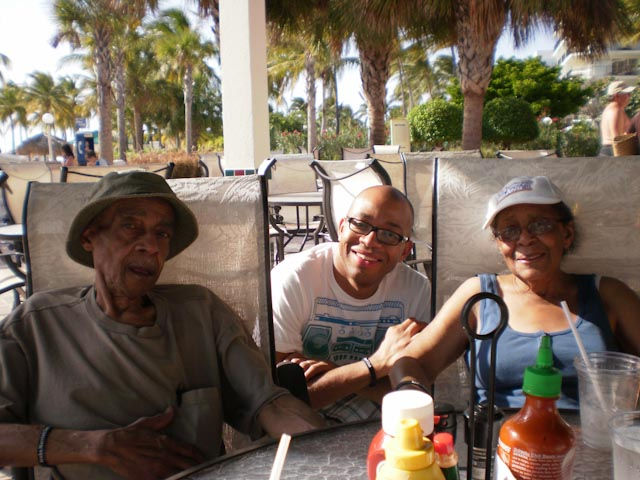
Travis with his grandparents - Eugene and Beverly Stradwick
Our work is not only to preserve what happened. It is to understand why it mattered, who it mattered to, and how to tell it in a way that honors both evidence and experience.
Travis’s interview reminds us that heritage is not only found in famous names or official records. Sometimes it is found in a steep street, a porch, a corner store, a payphone, a child’s game, and the long echo of laughter from a neighborhood that once sounded different than it does today.
We are honored to introduce Dr. Travis L. Gosa, my little brother, as part of our Meet the Board series.

We are grateful for his voice, his scholarship, his humor, his honesty, and his willingness to help the Foundation keep asking better questions.
And, as he says so well:
Let’s get to work.
-T
Dr. Travis Gosa was born and raised in Wheeling, WV. He is a graduate of Wheeling Park High School, and earned his Bachelor of Science in Political Science and Sociology from Shepherd University (Shepherdstown, WV). He received his M.A and Ph.D. in sociology from The Johns Hopkins University.Dr. Gosa brings a vast background in academic research on 20th and 21st century African American culture to the Foundation.
He was a professor of Sociology and Africana Studies at Williams College, then spent a decade at Cornell University’s Africana Studies and Research Center, where he held academic appointments in the departments of Education and American Studies.
He is the recipient of numerous fellowships and teaching awards for classes such as “The Socialization of Black Families and Children” and “The Politics of the Hip Hop Generation.”Dr. Gosa is the author of over twenty academic publications, while his public writing has appeared in outlets like USA Today, The Washington Post, The Root, The Chronicle of Higher Education, and Fox News.Likewise, Dr. Gosa is a recognized expert on the collection, preservation, and dissemination of black history.
Notably, he served on the advisory board of Cornell’s Hip Hop Collection—the largest library archive on hip hop culture in the world—and received several grants to establish physical and digital collections on 1970s South Bronx communities and the visual iconography of President Barack Obama.


