When the Walls Came Down: Remembering Clay School and Wheeling’s Forgotten Educational Legacy

Updated: Oct 3

When the former Clay School in East Wheeling was demolished in the summer of 2026, I had an opportunity to stand nearby and photograph its final days.
For some, it may have appeared to be the removal of an old, long-vacant building. For me, it was personal.
I entered Clay School as a kindergarten student in September 1976. I remained there through sixth grade, graduating in May 1982. For nearly seven formative years, Clay was part of the rhythm of my life—a place of teachers and classmates, lessons and friendships, ordinary school days and childhood milestones.
Watching its walls come down was therefore like watching part of my own history disappear.

But Clay’s significance reaches far beyond the years when I attended it. Its story stretches through three buildings, two centuries, the creation of West Virginia, the Civil War, segregation, desegregation, neighborhood change, and generations of Wheeling children.
It is an extraordinary history—and one that surprisingly few people know.
A Remarkable Newspaper Headline
A surviving newspaper article about an earlier Clay School carried an astonishing headline:
“Wheeling Had First Public School System in the South.”
Written as the old Clay building at Twelfth and Eoff streets was being demolished, the article looked backward to the beginnings of public education in Wheeling.

It reported that Wheeling’s earliest public school opened in October 1848, one block north of the future Clay School site. At that time, Wheeling was still part of Virginia. West Virginia would not become a state until 1863.
The school had been organized under authority granted by the Virginia General Assembly in 1846. On April 7, 1848, Third Ward school trustees James E. Wharton, W. J. Bates, and E. A. Hildreth advertised for proposals to construct a schoolhouse.
The resulting building occupied a lot measuring only 30 by 40 feet. It was two stories tall, with stone forming part of the lower level and brick used for the remainder of the structure.
Each of its schoolrooms contained 40 fixed desks, with two pupils assigned to each desk.
When the building was completed in September 1848, separate male and female departments were established. A. J. Halle served as principal and was assisted by his wife.
The school opened to Third Ward children between six and sixteen years old on the first Monday of October.
Its enrollment quickly demonstrated the community’s demand for education. The newspaper reported that 226 children enrolled during the first quarter. At the quarter’s end, 214 remained, with an average daily attendance of 186 pupils.
The numbers are remarkable for such a small building. They also reveal that overcrowded classrooms were part of Wheeling’s educational story from nearly the beginning.
A Pioneering System That Was Not Yet Equal
The newspaper’s claim that Wheeling had established the first public-school system in the South deserves attention, but it also requires historical care.
Definitions of “public school” and “school system” differed considerably during the nineteenth century, making sweeping national rankings difficult to prove. The safest conclusion is that Wheeling was an unusually early Southern adopter of locally organized, publicly supported education.
But the system was not open to everyone.
The law described in the article entitled the district’s white children, male and female, to receive tuition-free instruction. Black children were excluded.
That contradiction is essential to the story.
Wheeling could be progressive in creating public education while remaining profoundly unequal in deciding who was entitled to receive it. The city was helping to pioneer the principle that education should be supported by the public, but it had not yet embraced the principle that every child belonged within that public.
Black families would later build their own educational tradition through institutions such as Lincoln School, supported by teachers, parents, churches, and community leaders who refused to allow exclusion to extinguish their children’s ambitions.
By the time I entered Clay in 1976, a Black child could walk through its doors and claim a place in a school system from which Black children had originally been barred. That change did not occur naturally or inevitably. It was made possible by generations who challenged segregation and expanded the meaning of public education.
The First Clay School
As Wheeling’s population grew, the Third Ward needed additional space. In 1862—during the Civil War and one year before West Virginia achieved statehood—a new Clay School was erected at the southeast corner of Twelfth and Eoff streets.
The newspaper described Clay as the second public school constructed in the city and presented it as part of Wheeling’s pioneering position in Southern public education.
The old Clay was a substantial three-story red-brick structure enclosed by a cast-iron fence. Each floor contained four large classrooms with high ceilings. Its broad hallway, double-door entrance, and divided staircase gave the building an imposing presence.
For approximately 81 years, it served children in the heart of Wheeling.
As enrollment continued to grow, another building—variously known as Jefferson School, the Clay Annex, and later the Opportunity School—was constructed at Fourteenth and McColloch streets during the 1890s. It initially served younger pupils before becoming a center for children with special educational needs.
Clay was therefore never only one building. It was an expanding educational network created to serve the children of East Wheeling.
A New Clay Built During World War II
The Clay School that I attended was the third major chapter in this history.
In 1941, the school board purchased six parcels of land along Fifteenth Street for a combined $75,000. There, at the corner of Fifteenth and Wood streets, Wheeling constructed a new 35-room elementary and junior-high school with an auditorium and gymnasium.
Building such a facility during World War II was extraordinarily difficult. Construction materials were scarce or reserved for the war effort. Mills that ordinarily produced building materials had been converted to military production.
Even the architects were affected by the war. According to the historical account preserved by the Ohio County Public Library, the original architect accepted an Army commission and his successor entered the Navy. Architect Phillip Faris ultimately supervised the building’s completion.
The site presented physical difficulties as well. Springs beneath the hillside had to be brought under control to protect the new structure.
Despite wartime shortages, personnel changes, and challenging terrain, the new Clay School was completed in 1943. That same year, the old building at Twelfth and Eoff ended its long service.
The new Clay was designed to be more than a collection of classrooms. Its auditorium and gymnasium made it a place where the community could gather, perform, compete, and celebrate. Its size reflected the importance of the school to East Wheeling and the expectation that it would serve many generations.
It did.
The Year My Clay Story Began
My first year at Clay coincided with another important transition in the school’s history.
In the fall of 1976, Clay’s junior-high students were moved to the former Wheeling High School building at 2115 Chapline Street. Clay was then remodeled to serve the elementary grades more effectively.

That was the same fall I entered kindergarten.

I did not know it at the time, but I was arriving just as the building began a new chapter. The school that had opened during World War II as a combined elementary and junior high was becoming the neighborhood elementary school I would know.
From September 1976 through May 1982, Clay carried me from my first classroom experiences through sixth-grade graduation.
Like most children, I did not enter the building each morning thinking about legislation passed in 1846, the first Third Ward school of 1848, the Civil War-era Clay School of 1862, or the wartime construction challenges of 1943.
I simply knew it as my school.
That is how historic places often become part of us. Their significance is absorbed through ordinary experience: walking the same hallways each morning, recognizing the sound of the bell, learning the location of every classroom, gathering in the auditorium, entering the gymnasium, and sharing years of life with teachers and classmates.
Only later do we understand that our personal memories belong to a much larger story.

A School for a Changing Community
By the 1970s and 1980s, Clay served children from a community very different from the one that had created Wheeling’s first free schools.
The original nineteenth-century system had expressly limited tuition-free education to white children. The Clay I attended existed after desegregation, when children of different racial and religious backgrounds learned beneath the same roof.
That transformation gives Clay special importance to the Eugene and Beverly Stradwick Heritage Foundation.
Clay allows us to trace the distance between public education as it was first conceived in Wheeling and public education as later generations demanded it become. It connects a whites-only system of 1848 with the experience of Black children who, more than a century later, entered the same educational tradition as full participants.
The history was neither simple nor complete. Desegregation did not erase every inequality, and East Wheeling continued to face economic hardship, disinvestment, and social challenges. Yet inside Clay, teachers and staff worked to make the school a place of learning and security for neighborhood children.
Its significance rests not only in architecture or dates, but in the thousands of lives shaped there.
Closure, Vacancy, and Unfulfilled Plans
Clay continued operating until the mid-1990s. After the Ohio County Board of Education approved its closure, the building became vacant in 1996.
For approximately three decades, numerous ideas were proposed for reusing the enormous structure. At different times, supporters imagined housing, educational programming, science activities, and community services within its walls. None of those efforts produced a lasting redevelopment.
The City of Wheeling acquired the property in 2021 with the initial intention of rehabilitating it. After a feasibility study, environmental review, and public-input process, City Council voted in February 2025 to proceed with demolition. Hazardous materials first had to be removed with support from a federal Brownfields grant. Demolition began in April 2026 and was officially completed in August.

The city has discussed constructing an indoor community or recreational facility that could complement the neighboring J. B. Chambers Memorial Recreation Complex. As of this writing, however, the final future of the site remains to be determined.
The building is gone. The decision about what will rise in its place still lies ahead.
Photographing the End
I am grateful that I had the opportunity to photograph Clay School as it was being demolished.

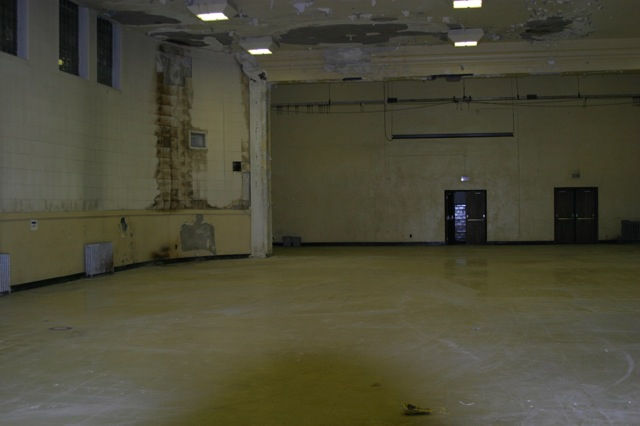
The photographs I will share with this article are not images of the school as I knew it as a child. They show broken walls, exposed rooms, heavy machinery, falling brick, and the gradual disappearance of a structure that once seemed permanent.
But they also reveal something deeply human.
When an exterior wall comes down, rooms once hidden from the street become visible. Spaces that held lessons, conversations, discipline, laughter, disappointment, discovery, and friendship are briefly exposed before they disappear forever.

I was not photographing only the demolition of a building.
I was documenting the closing of a physical chapter in my own life and in the history of East Wheeling.

Clay School Is Gone, but Its History Remains
Clay School’s story began long before the building at Fifteenth and Wood streets opened in 1943.
Its roots reach back to Wheeling’s earliest experiment with public education in 1848. They pass through the Civil War-era Clay School built in 1862, the Clay Annex of the 1890s, the construction of a new school during World War II, the transition from junior-high to elementary education in 1976, and the generations of children who carried their experiences into adulthood.

Clay’s history also forces us to confront a defining American contradiction. Wheeling was early in recognizing education as a public responsibility, but its original system excluded Black children. More than a century later, I entered Clay as a kindergarten student and remained through my sixth-grade graduation.

That personal journey does not erase the history of exclusion. It helps reveal the change created by those who struggled against it.
The walls have now come down, but Clay School should not be allowed to vanish from Wheeling’s collective memory.

We must preserve its photographs. We must collect its records. We must record the voices of former students, teachers, staff members, parents, and neighbors. We must remember not only when the building opened and closed, but what happened inside it and what it meant to the community surrounding it.
A school is ultimately more than brick, stone, wood, steel, classrooms, or hallways.
It is the lives that passed through it.
Clay School lives in those lives—including mine.
-T



Sources and Research Notes
Primary historical source: Peter C. Boyd, “Wheeling Had First Public School System in the South,” Wheeling newspaper clipping, Page 8 of Wheeling News Register, published in Wheeling, West Virginia, on Sunday, March 25th, 1945. The approximate date is based on the article’s statement that the 1862 Clay School had been built 83 years earlier. The clipping documents the establishment of Wheeling’s Third Ward free school in 1848, the construction of Clay School in 1862, early enrollment, school governance, curriculum, and the original system’s exclusion of Black children.
Clay School history: Levering C. Bonar, A Collection About Ohio County Public Schools (1978), excerpted by the Ohio County Public Library. This source documents the Clay locations, the 1941 land purchases, wartime construction difficulties, the 35-room 1943 building, and the fall 1976 relocation of the junior-high program.
Recent site history: The City of Wheeling’s Clay School remediation page documents the building’s prolonged vacancy, the city’s 2021 acquisition, environmental work, and the 2025 decision to demolish it. The city’s February 4, 2025 resolution identifies a community or recreation center as the intended goal rather than a finalized construction project. Local reporting confirmed that demolition was completed in August 2026.
Personal history: The author attended Clay School from kindergarten in September 1976 through sixth-grade graduation in May 1982 and personally photographed the building’s demolition.
Research caution: The claim that Wheeling operated the first public-school system in the South comes from the historical newspaper article. Because definitions of “public school” and “school system” varied, it should be presented as a significant local historical claim rather than an uncontested national ranking.


